We are making this site for those who are making preparation of becoming IAS, IPS, Officers as well as who are making preparation of UPSC and becoming class one officer.
We are uploaded best and useful video collection of past Interview conducted for IAS, IPS and UPSC exam.In short all are most important and useful Interview Videos for Class One Officer Exam.
Improve Your knowledge and make fun with this videos.
We are select best videos and uploaded to this blog.
An MP asked if Facebook had read and evaluated the T&C for the app
We did not read all the terms and conditions: Facebook CTO
For Facebook, the acknowledgement could prove troubling to investigators
Facebook told British lawmakers on Thursday that it never read the terms and conditions for an app that ultimately allowed Cambridge Analytica to access 87 million users' names, "likes" and other personal information.
The admission from Mike Schroepfer, the chief technology officer for the social media giant, concerns a quiz app made by researcher Alexander Kogan, and his firm known as GSR, which collected data on users who authorized it, as well as scores of their friends. It then transferred that data to Cambridge Analytica, a political consultancy that later had been hired by President Donald Trump, so that the firm could assemble psychographic profiles of voters.
Schroepfer is representing Facebook in British parliamentary hearings, one of multiple investigations around the world into the company's privacy practices.
On Thursday, Jo Stephens, a member of Parliament, asked Facebook if it had read and evaluated the terms and conditions for Kogan's app, called ThisIsYourDigitalLife, before allowing it on the platform. Facebook's Schroepfer replied: "We did not read all the terms and conditions."
Facebook changed its policies in 2014, prohibiting developers from obtaining information about users as well as their friends. Schroepfer said the new oversight included a "move to a proactive review process where if an app developer wanted access to additional data they would have to go to a review with our teams."
Yet he could not say if Facebook read the terms of use for all apps allowed on the site prior to changing its policy or banning Kogan's tool in 2015. "I can't say we never read them, I think it wasn't a requirement that we read them," Schroepfer said.
For Facebook, the acknowledgment that it didn't closely study the apps on its platform could prove troubling to investigators in Europe as well as the United States.
Along with the UK, which has held hearings to probe the matter, regulators with the European Union are also studying the Cambridge Analytica controversy. The EU's Parliament has asked Facebook CEO Mark Zuckerberg to testify at an upcoming hearing, but he has not committed to an appearance.
In the United States, Facebook is facing the potential of massive fines from the Federal Trade Commission if the agency determines that the company misled users about its privacy protections. Facebook also revealed recently that malicious actors scraped public profile data from the site's roughly 2.2 billion users.
Facebook said 1,040 people in the UK had installed Kogan's app, which allowed it access to around 1 million friends' personal information. They and others have been notified, as Facebook undergoes a review of all apps on its platform and their privacy practices. Schroepfer said Thursday he could not give a precise timeline as to when the review would be completed.
Facebook also told UK lawmakers on Thursday that it would seek to ensure political ads targeting British lawmakers and voters are more transparent, much as it has pledged to do in the United States. It will vet and label those ads in time for local elections in May 2019, Schroepfer said.
Republicans suggested that content from conservatives are being censored
Lawmakers agreed tech companies must remove illegal content
Members differed on whether objectionable content should be removed
Democrats and Republicans in the US House of Representatives on Thursday sparred over the role of social media platforms Facebook, Google and Twitter in filtering content after representatives of the tech companies skipped a hearing.
Republicans repeatedly suggested at a House Judiciary Committee hearing that Facebook, Alphabet's Google and Twitter are censoring or blocking content from conservatives, a charge the companies denied.
Lawmakers from both parties agreed tech companies must remove illegal content like fraud, piracy and sex trafficking but differed on whether they should remove objectionable content.
Representative Robert Goodlatte, a Republican who chairs the committee, said he was "extremely disappointed" the companies did not testify.
Goodlatte said the First Amendment of the US Constitution "offers no clear protections for users when Facebook, Google, or Twitter limits their content in any way."
Alphabet did not respond to requests for comment. Twitter declined to comment, while Facebook said it would keep talking to Congress about "Facebook's strong commitment to being a platform for all voices and ideas."
Goodlatte said "while these companies may have legal, economic, and ideological reasons to manage their content like a traditional media outlet, we must nevertheless weigh as a nation whether the standards they apply endanger our free and open society and its culture of freedom of expression."
Representative Jerrold Nadler, top Democrat on the committee, said "the notion that social media companies are filtering out conservative voices is a hoax, a tired narrative of imagined victimhood."
Nadler added "conservative commentary, including conspiracy theories of a conservative bent, regularly rank among the most far-reaching posts on Facebook and elsewhere."
The hearing featured a pair of pro-Donald Trump sisters known as "Diamond and Silk." Representative Marsha Blackburn, a Republican, testified about Twitter's decision to block her from advertising a campaign video the company called "inflammatory." Twitter reversed the decision.
"We need to recognise that the global reach of these companies creates overwhelming pressure against free speech, and we need to do a much better job counteracting that pressure," Blackburn said.
Representative Ted Lieu, a Democrat, said the US government should not follow authoritarian practices.
"What makes America great is we get to say stuff and not have the government intervene," Lieu said. "This is a stupid and ridiculous hearing."
Berin Szoka, president of TechFreedom, said "concerns about Facebook's potential slant are best addressed through other measures, starting with transparency and user empowerment. Ultimately, the best check on Facebook's power today is the threat of a new Facebook disrupting the company's
Online search engine Google is the most trusted Internet brand in India, followed by Facebook, a report said on Wednesday.
"With 1.2 trillion searches per year, it (Google) has become the first port of call for all things on the Internet," the TRA Brand Trust Report 2018 said.
It further said: "Facebook, ranked second in the list, has been steadily climbing the trust ladder over the years (ranked seventh in 2015, fourth in 2016 and third in 2017 BTR reports)."
The survey, however, was carried out during November 2017-January 2018 and did not take into account the recent reports of data breach and privacy involving Facebook, said N. Chandramouli, CEO, TRA Advisory.
He further said the impact of privacy concerns are likely to affect Facebook's ranking in the next survey.
According to the report, e-commerce major Amazon ranked third among the most trusted Internet brands in the country and eBay ranked fourth. The other major e-commerce brand Flipkart was positioned sixth in the brand trust report.
Among the online taxi aggregators, Ola ranked seventh in the list, surpassing Uber which took the fifteenth position.
"Internet brands yet have much scope for disruption. Initially Internet disrupted the traditional businesses, and now new models are threatening other Internet businesses with better and more efficient models," Chandramouli said.
"Only the Internet brands with a prudent business model, one which focusses on brand trust along with profits and growth will survive the next couple of years," he added.
MIUI will now release the last Development/Alpha ROM 8.4.26
It hints at the arrival of MIUI 10
Smartphones based on Android 5 Lollipop will not get major updates now
Xiaomi on Wednesday announced the suspension of MIUI 9 Beta ROM updates after April 27. The Chinese smartphone manufacturer had unveiled its custom Android ROM - MIUI 9 - in July last year. In an MIUI Forum, an admin has informed that MIUI will now release the last Development/Alpha ROM 8.4.26 to "achieve better system stability and optimisation." In the coming months, MIUI developers will focus on system optimisation and according to Xiaomi, the updates will be resumed in June. Interestingly, in a similar post, an MI Community admin detailed information about the suspension of MIUI Global Beta ROMs as well.
Based on Android 7.0 Nougat, MIUI 9 had brought several features such split screen, faster app launch times, a more dynamic resource allocation for a fluid experience, and other smart features and improvements. In November 2017, Xiaomi had announced the rollout of MIUI 9 Global ROM in India. There were tons of improvements including new design elements, lock screen shortcuts, split screen feature, and more.
Earlier in January 2018, Xiaomi had announced the development of MIUI 10 as well. It was clear from the reports, that the main focus for MIUI 10 developers will be artificial intelligence and machine learning. Notably, in the latest post on MIUI Forum, Xiaomi has not mentioned any details about the development of MIUI 10.
It is worth noting that smartphones based on Android 5.x Lollipop will not be supported for any major update now. Xiaomi stated that smartphones such as Redmi Note 2, Redmi Note 3, Redmi 3, and Mi Pad 2 will not be compatible with the next update and MIUI 8.4.26 will be the last MIUI Beta ROM update on these handsets. Users of such smartphones can either stay on MIUI China Beta ROM or switch to MIUI 9.6 China Stable ROM update, which may arrive in June this year.
To recall, last year in November, Xiaomi had announced that MIUI 9 will be the last update for six smartphones, including Mi 2/2S, Mi 4i, Redmi Note 4G, Redmi 2, Redmi 2 Prime, and the Mi Note. As of now, MIUI 9.5 Global Stable ROM is rolling out in India.
The new Airtel Rs. 219 recharge is the same as the Rs. 199 pack but comes with free Hello Tunes
HIGHLIGHTS
Airtel's Rs. 219 plan offers 39.2GB of 4G data
Validity period of the plan is 28 days
Plan offers unlimited Hello Tunes
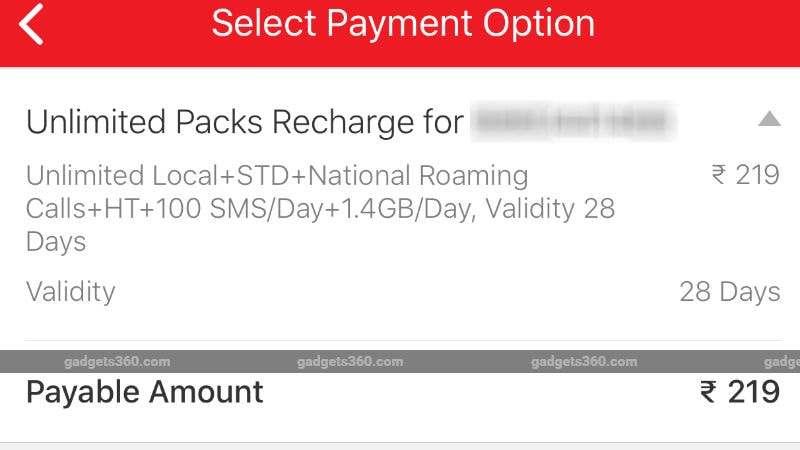
Jio continues to remain the most affordable telecom operator in India if data consumption is your priority. Airtel and the other incumbents have tried to match it and have indeed come closer, but still don't quite match its prices and bundled data. Now, to take on the Jio Rs. 149 and Rs. 198 recharges, Airtel has launched the Rs. 219 pack for prepaid users. This joins the Airtel Rs. 199 prepaid recharge and comes with validity of 28 days and data allocation of 1.4GB per day. In fact, it is nearly identical to the Rs. 199 recharge, but comes with free Hello Tunes
The new plan by Airtel is aimed at subscribers who like to set caller tunes on their numbers. Airtel's competitor Jio has been offering this service for free. To avail the Rs. 219 plan, Airtel prepaid users will need to open the My Airtel app or go to the company's website. Also, if you are not interested in setting Airtel Hello Tunes, you can still go for the Rs. 199 plan that offers 1.4GB data per data per day or 39.4GB data for 28 days, along with unlimited calls. Both recharges offer free local and STD calls, free roaming, 100 SMSes per day, and access to Airtel TV app.
When it comes to offers close to Airtel's Rs. 219 plan, Jio has recharge packs worth Rs. 149 and Rs. 198, as mentioned above. Under the Rs. 149 plan, Jio is currently offering 1.5GB data per day for a validity period of 28 days and in the Rs. 198 recharge pack, Jio users will get 2GB of data per day for 28 days. Voice calling is free on both packs, and users get 100 SMSes per day and a free subscription to the company's proprietary apps.
To recall other new offers from Airtel, the company recently launched the Rs. 249 recharge pack and updated its Rs. 349 pack to offer more data to consumers. Airtel is offering 2GB data per day for 28 days at Rs. 249, and it has revised its Rs. 349 pack to offer 3GB data per day for 28 days, up from 2GB per day. Also, another new Airtel plan worth Rs. 499 provides 2GB of daily data for 82 days.
The render also highlights the absence of a home button
Just days after Lenovo-owned Motorola brought a series of its new Moto G and Moto E models, a press render showing the design of the anticipated Moto Z3 Play has emerged online. The render clearly reveals a thin-bezel display panel and a dual rear camera setup on the smartphone that will be the successor to the last year's Moto Z2 Play. It also shows a glass back and the Pogo pin connector to establish compatibility with Moto Mods. The latest development comes weeks after the Moto Z3 Play reached the US FCC and was leaked in some case renders. An initial image of the smartphone was spotted in January that suggested a smart camera experience.
The fresh render, which has been sourced by Android Headlines, is touted to be part of the official press materials from Motorola. It shows many similarities with the images that have been leaked so far. On the front, the press render highlights that the Moto Z3 Play has ditched the home button and is instead featuring on-screen keys. The absence of the home button makes more space for the display panel that is already rumoured to have an 18:9 aspect ratio. The display is also expected to come in a 6-inch size and with full-HD+ (1080x2160) pixels resolution. Moreover, there isn't a fingerprint sensor available on the front, as per the leaked press render. This suggests that the smartphone might have a fingerprint sensor module hidden under its power button.
On the back, the press render shows that the glass panel of the Moto Z3 Play that makes it a premium-looking device. There is also the dual rear camera setup alongside a Moto logo and a Pogo pin connector.
If we look back at the previous reports, the Moto Z3 Play will come with a Snapdragon 636 SoC, coupled with 4GB of RAM and 32GB/ 64GB of onboard storage. The smartphone is also said to come with a 12-megapixel primary sensor and an 8-megapixel secondary sensor on the back and a 5-megapixel camera sensor on the front. Furthermore, it is rumoured to come with a 3000mAh battery and run Android Oreo out of the box.
Apple Watch Series Cellular variant offers voice calling
It has LTE connectivity independent an iPhone
It was launched back in September
Apple Watch Series 3 Cellular variant is coming to India soon, something we reported earlier this week, with pre-bookings on Airtel and Jio starting from May 4. Now, Gadgets 360 has learnt the Apple Watch Series 3 Cellular variant price in India will start at Rs. 39,080, and that it will be made available via Apple retail partners in India as well, apart from the Airtel and Jio portals as previously reported. To recall, the GPS-only version of the Apple Watch Series 3 (Review) was launched in India last year, and its price in India starts from Rs. 32,380 - representing a Rs. 6,700 premium for the 38mm Cellular variant.
Gadgets 360 has learnt the prices of all the Apple Watch Series 3 Cellular variants in India. The 38mm Apple Watch Series 3 Cellular variant with Aluminium case and Sport Band is priced at Rs. 39,080, and represents the base model. The 42mm Apple Watch Series 3 Cellular variant with Aluminium case and Sport Band is priced at Rs. 41,120. The 38mm Apple Watch Series 3 Cellular with Aluminium case and Nike Sport Band is priced at Rs. 39,130, while the 42mm Apple Watch Series 3 Cellular variant with Aluminium case and Nike Sport Band is priced at Rs. 41,180.
Launched alongside the iPhone 8 and iPhone 8 Plus in September last year, the Apple Watch Series 3 GPS + Cellular supports only a built-in embedded SIM (eSIM) to offer cellular connectivity. This allows the user to retain the same mobile number as the one on the iPhone, and will allow users to go for a run while leaving their phones at home. It will also let users make calls and stream Apple Music directly from the Watch further bringing down the dependability on the iPhone. Apple Watch Series 3 (GPS + Cellular) requires an iPhone 6 or later with iOS 11 or later.
TCL on Thursday launched its latest smart TV offerings in India - iFFALCON 55K2A powered by Android 7.0 Nougat and iFFALCON F2. While the iFFALCON 55KA is a 55-inch TV with a 4K UHD display, the iFFALCON F2 TV comes in two configurations - the 40-inch variant called iFFALCON 40F2 and the 32-inch variant called iFFALCON 32F2. In their price range, the TCL iFFALCON TV lineup will compete with Xiaomi's Mi LED Smart TVs.
The company has also partnered with Jio Digital, Netflix, Google Play Movies & TV, YouTube, ErosNow, Voot, and more for content. TCL iFFALCON's three models will be available for purchase from May 7 via the Flipkart iFFALCON brand store. The iFFALCON 55K2A has been priced at Rs. 45,999, while iFFALCON 40F2 and iFFALCON 32F2 will be available at Rs. 19,999 and Rs. 13,499 respectively. Additionally, all the three iFFALCON models will come with a bundled cashback offer with JioFi data card.
TCL iFFALCON Smart TVs specifications
The iFFALCON 55K2A is a flagship offering from TCL. The 4K UHD TV sports a 55-inch display with full-HD (3840x2160 pixels) resolution. It is powered by a quad-core processor and a dual-core GPU, paired with 2.56GB of RAM and 16GB inbuilt storage.
The iFFALCON 55K2A also comes equipped with Micro Dimming technology and white LED HD backlight that enhances the colour gamut and claims to provide more dynamic colour contrast. It also has Dolby 5.1 Surround Sound and advanced DTS post-processing technology. It has a Smart Volume feature that automatically adjusts the volume to eliminate sudden sound fluctuations.
Powered by Android 7.0 Nougat, the iFFALCON 55K2A comes with features such as task switching, picture-in-picture, and inbuilt Google Chromecast. Also, users can install apps from other devices through a multiple platform sync feature. You can use Google Voice Search as the TV remote has a dedicated button to receive voice inputs.
Coming to the TCL iFFALCON F2, the TV comes equipped with features like full-HD and Micro Dimming technology. This TV also has the LED HD backlight that enhances the colour gamut and provides dynamic contrast. In the app store, iFFALCON F2 provides a range of downloadable content from more than 500 apps. The TV comes pre-installed with Netflix.
The iFFALCON F2 comes with T-Cast, an integrated feature that allows users to operate the TV via their smartphones. The TV features the Dolby decoder and supports a variety of audio and video formats. It has some safety features such as lightning protection, fast heat ventilation, and wide voltage range. TCL claims that the TV consumes significantly lower power and is moisture-proof.
Samsung has launched the Galaxy J2 (2018) in India
The new smartphone comes preloaded with Samsung Mall app
It is priced at Rs. 8,190
Samsung Galaxy J2 (2018) has been launched in India. The new smartphone, which is the successor to the Galaxy J2 (2017), comes pre loaded with a Samsung Mall app that is claimed to use artificial intelligence (AI) to let users shop online by clicking a picture of their desired product. Samsung has also tied up with Reliance Jio to offer an instant cashback of Rs. 2,750 via the MyJio app on recharging with Rs. 198 or Rs. 299 packs. Further, customers would get an additional 10GB of data on every recharge for the next 10 recharges. The Galaxy J2 (2018) price in India is Rs. 8,190 and it will go on sale starting April 27 in Black, Gold, and Pink colour options. The Samsung Galaxy J2 (2018) is the Indian variant of the Galaxy J2 Pro (2018) that was launched in Vietnam earlier this year.
Samsung Galaxy J2 (2018) features
The availability of the Samsung Mall app on the Galaxy J2 (2018) brings three key features, including a Visual Search, One-stop Shop, and a Universal Cart. The app debuted on the Galaxy On7 Prime back in January and is touted to simplify users' shopping experience. The Galaxy J2 (2018) also comes with a 'Device Maintenance' feature that optimises its performance. Similarly, there is a memory-saving proprietary 'Move to Memory Card' feature that automatically directs content from social media apps to the external memory card.
Samsung Galaxy J2 (2018) specifications
The dual-SIM (Micro) Galaxy J2 (2018) runs Android 7.1 Nougat and features a 5-inch qHD (960x540 pixels) Super AMOLED display. Under the hood, there is a 1.4GHz quad-core Qualcomm Snapdragon 425 SoC, coupled with 2GB of RAM.
The Galaxy J2 (2018) has an 8-megapixel camera sensor on the back, while a 5-megapixel camera sensor is available on the front. Both camera sensors are accompanied by an LED flash. The smartphone has 16GB of onboard storage that is expandable via microSD card (up to 256GB). The smartphone has Wi-Fi 802.11 b/g/n, Bluetooth v4.2, GPS/ A-GPS, and Micro-USB. Sensors on board include an accelerometer and a proximity sensor. Besides, the handset packs a 2600mAh battery and measures 143.8x72.3x8.4mm.
"Galaxy J2 2018 reiterates Samsung's commitment towards meaningful innovations that delight our customers. For this device, we focused on two trends amongst Indian youth - the growth of online shopping and high usage of Social media platforms. Samsung Mall uses artificial intelligence to revolutionise the way customers shop online with a visual search. For avid social media users, Samsung's proprietary 'Move to Memory Card' feature is an advanced memory management solution that de-clutters the internal memory, thereby enhancing the smartphone experience," said Sumit Walia, Director, Mobile Business, Samsung India, in a press statement while announcing the new launch.
Three months Netflix free when you buy one year of PS Plus
This offer is valid in India and most of Europe
However, you need to receive an email from Sony to claim it
Sony is offering three months of Netflix for free with yearly PlayStation Plus subscriptions. This deal isn't live globally just yet, although it is available in India and most of Europe right now, provided you've received an email from the company with the offer of free Netflix. That said, several members of popular gaming forum ResetEra have confirmed that they have received access to the offer via email, which comes with a personalised link to purchase a one year PS Plus subscription. PS Plus is Sony’s service that allows for online multiplayer, cloud saves, and access to games each month for a fee.
A legal page on Sony's website backs up their claims, stating that these are being sent out to specific users.
"User must have received an email from the Promoter informing them of the promotion (the “Promotion Email”). Note: only users selected by the Promoter and who have opted in to receive promotional/marketing communications from the Promoter will be eligible)," reads Sony's terms and conditions for getting access to free Netflix.
Partaking in this offer entitles a user to three months of the Netflix Service on Netflix’s Standard (HD) Streaming Plan with purchase of a one year PS Plus subscription. The offer ends on May 4 at 2:30pm IST.
Countries eligible for this offer include Australia, Austria, Belgium, Bulgaria, Croatia, Cyprus, Czech Republic, Denmark, Finland, Germany, Greece, Hungary, Iceland, India, Ireland, Israel, Italy, Luxembourg, Malta, Netherlands, New Zealand, Norway, Poland, Portugal, Romania, Russia, Slovakia, Slovenia, South Africa, Spain, Sweden, Switzerland, Turkey, Ukraine, and United Kingdom.
Previously we reported that PS Plus prepaid cards had made their way to India. Specialist games store Games The Shop has listed the PS Plus three month membership card for Rs. 1,899. Compared to buying it digitally, you’re paying Rs. 30 more, which isn’t too much considering you don’t have to worry about your credit or debit card working on the PS Store or not. It's also available on Amazon India via third-party sellers.
WhatsApp Business is only available for Android at the moment
WhatsApp Business has an active user base of over 3 million people, Mark Zuckerberg has said. The WhatsApp Business user base was revealed in Facebook's Q1 2018 earnings call, Venture Beat reported late on Wednesday It is a standalone app separate from the other version of WhatsApp used by 1.5 billion people, was launched in January for Android users in six countries - India, Indonesia, Italy, Mexico, Britain, and the US.
WhatsApp Business competes with services like Apple's Business Chat and RCS messaging for Android and Facebook's own Messenger Platform, chat apps offering features that help businesses connect with customers. While it is still being rolled out, conversational commerce through things like payments on Messenger will also be important to the social media giant, the report said.
"Over the next five years we're focused on building out the business ecosystems around our apps like Instagram, WhatsApp and Messenger," Zuckerberg said. "I think what you're going to start to see are people interacting with Pages that you follow, Pages on Facebook or Instagram.
"You see content from that Page, and you can click through to a message thread, and then you can either get customer support or complete a transaction or do a follow-on transaction, and that will be very valuable for businesses so we view the payment in that context, not as the goal but as something that's helping the business and the person succeed at having a transaction or doing what they're trying to do," Zuckerberg noted.
WhatsApp Business, available on Google Play, makes it easier for companies to connect with customers, and more convenient for its users to chat with businesses that matter to them. The new app, which is yet to be launched on the App Store, asks for a separate phone number from the one users have for their individual WhatsApp account.
OnePlus 6 design with the thin bezels all around and the notch is shown in the image
HIGHLIGHTS
OnePlus 6 live spotted in a leaked image
The image shows the interface of the upcoming OnePlus smartphone
It also highlights the notch design
OnePlus 6 has already become one of the most teased smartphones of the year - thanks to the tons of teasers that OnePlus publicly circulated so far. And now, the OnePlus 6 has been spotted in a live image that shows the front of the smartphone as well as the already confirmed notch design as well as a thin-bezel display. The latest development comes just after the company formally announced the OnePlus 6 launch date for the global as well as India and China regions. Also, the leaked image matches perfectly with the renders that surfaced in the recent past.
The image, courtesy Techtastic, is apparently a fresh one as it sports a date stamp of April 23. It doesn't detail the design of the OnePlus 6 due to the presence of a special case that is purposefully hiding the outer frame. Nevertheless, the leaked image shows the wallpaper of the OnePlus 6 alongside the instances of Android 8.1 Oreo that can be seen from the status bar, icons, and the on-screen buttons. The smartphone also sports the "Never Settle" company motto. Besides, you can see the notch that the company already confirmed formally. It will have a room for an earpiece and front-facing camera sensor and include an ambient light sensor and proximity sensor.
As per some of the latest revelations made officially, the OnePlus 6 will come with a glass back and is expected to feature a water-resistant build. The smartphone is also likely to include a Snapdragon 845 SoC, paired with 8GB of RAM, and feature up to 256GB of onboard storage. Additionally, there are speculations that the next-generation smartphone will have a 'Slide to Focus' option and a larger, 3450mAh battery. The company has also tied-up with Marvel Studios to launch a OnePlus 6 x Marvel Avengers Limited Edition in India.
The India launch of the OnePlus 6 is set for May 17, the same day when the handset will debut in China. However, the global event is scheduled in London for May 16.
Doctor Strange, Tony Stark, Bruce Banner, and Wong in Avengers: Infinity War
HIGHLIGHTS
Avengers: Infinity War is out Friday, April 27
It follows Thanos going after the Infinity Stones
An untitled sequel, Avengers 4, will release in 2019
The most frequent complaint for Marvel's biggest movies has been a lack of stakes. For all the hell unleashed by Loki (Tom Hiddleston) and his Chitauri army in The Avengers, Ultron and his army of robot clones in Age of Ultron, or the Avengers’ internal dispute that was at the centre of Captain America: Civil War, our heroes have more or less come out unharmed at the other end. Characters who seemingly died have been brought back in the same film, be it Nick Fury in The Winter Soldier, Groot in Guardians of the Galaxy, or Loki in Thor: The Dark World. The trouble with all that is when audiences know the characters are being kept away from any serious consequences, there’s no real gravitas in the danger posed by the villains.
Anthony and Joe Russo, the directing duo of Avengers: Infinity War – in addition to Civil War and The Winter Soldier previously – know this better than anyone. And because this new mega team-up is the beginning of the end for the current generation of Marvel superheroes, and because the film has dozens of characters, it can do away with some and still have plenty to go around. That helps generate stakes and makes Infinity War different from any other Marvel film. Moreover, the film clearly establishes early on, that Thanos (Josh Brolin) is extraordinary powerful, and his four minions – his adoptive children like Gamora (Zoe Saldana) and Nebula (Karen Gillan) were – are quite capable on their own. That ensures the villains are taken seriously, and that there's a heft to them.
At the same time, it’s amazing that the film, written by Christopher Markus and Stephen McFeely – they also penned The Winter Soldier and Civil War – has a handle on every character and makes sure their idiosyncrasies, mannerisms, and behaviours get a glimpse, which provides a lot of humour within its otherwise heavy self-serious narrative. It’s fun to see Peter Quill's (Chris Pratt) insecurity rub up against Thor’s (Chris Hemsworth) hyper-masculinity, the collision of egos between Tony Stark (Robert Downey Jr.) and Doctor Strange (Benedict Cumberbatch), Cap's (Chris Evans) inability to understand humour, or even the clash between Bruce Banner and Hulk (Mark Ruffalo).
In addition to the delight of seeing various characters who've never met each other rub off on one another, talk shop, and exchange banter, it's also staggering to see how much Marvel's universe has grown when it's all brought together on a single canvas. The directors and the writers deserve praise for not making Infinity War feel rushed, as it has plenty of quiet meaningful moments for its characters, especially for Vision (Paul Bettany) and Scarlet Witch (Elizabeth Olsen), Quill and Gamora, and Stark. This isn’t true for most of the others, such as Cap and Black Panther (Chadwick Boseman), but that Infinity War can craft some genuine heart-breaking moments in such a massive get-together is a marvel.
Avengers: Infinity War begins where Thor: Ragnarok’s post-credits stinger left off, with Thanos’ ship intercepting the Asgardians. Infinity War uses Thanos as its viewpoint, as he goes after the Infinity Stones one by one. His goal is to collect all six, with which he could then wipe out half the universe with a snap of his fingers. Earth is important because two of the powerful, glowing ingots are here. One’s in the care and protection of Doctor Strange, while the other is embedded in Vision’s forehead, essentially keeping him alive. As they try to stop him, the film divides up the heroes: Thor ends up with the Guardians momentarily; Iron Man, Strange, and Spider-Man end up together; and the rest secure Vision in Wakanda.
Spider-Man, Iron Man, Drax, Star-Lord and Mantis in Avengers: Infinity War
Everyone, except Ant-Man and Hawkeye, is involved into the universe-spanning conflict. To not let the scale overpower it, Infinity War is smart about a few things. Early on, by anchoring the camera on the same height as our human heroes, it lets us feel the impact and power of things. Again and again, it forces the character emotionally closest to the character-at-risk to make a crucial decision, which deepens and rewards the audience’s investment. And it presents a twisted and half-compelling argument of Thanos’ solution to overpopulation in the Universe, egged on by what he saw on his home planet, Titan. That he’s revealed to be a more layered villain than what’s been presented in the post-credits scenes is a surprise, and his CGI-driven looks have been toned down, which also helps matters.
Better yet, Infinity War can fuse that with a constant sprinkling of levity, letting the goofier characters mesh alongside the more straightforward ones, though its villains never get that treatment as Rian Johnson did with Star Wars: The Last Jedi. Like it, Infinity War goes to some dark places, but then pushes further: there are no punching-the-air moments in the film’s final third. Most films on this scale get to be dark for a while, and then end in a climactic battle where heroes win the day. But since Infinity War will be followed by Avengers 4, it can essentially go to much darker places. The heroes are never on the winning side when it comes to Thanos.
It’s also why the Infinity War can deliver such a gut punch of an end. At the premiere in India, it left the theatre entirely silent during the credits. But the end is also deliberately unfinished, because despite what the directors say, the film feels like the first half of a two-parter. The true impact of Infinity War will only be felt once Avengers 4 rolls around, and to what extent it reverses the events that unfold in the final moments of this film. Given how important some heroes are financially to Disney-Marvel, how far it goes, and a throwaway hint to a solution, it seems likely that much of it won’t be permanent.
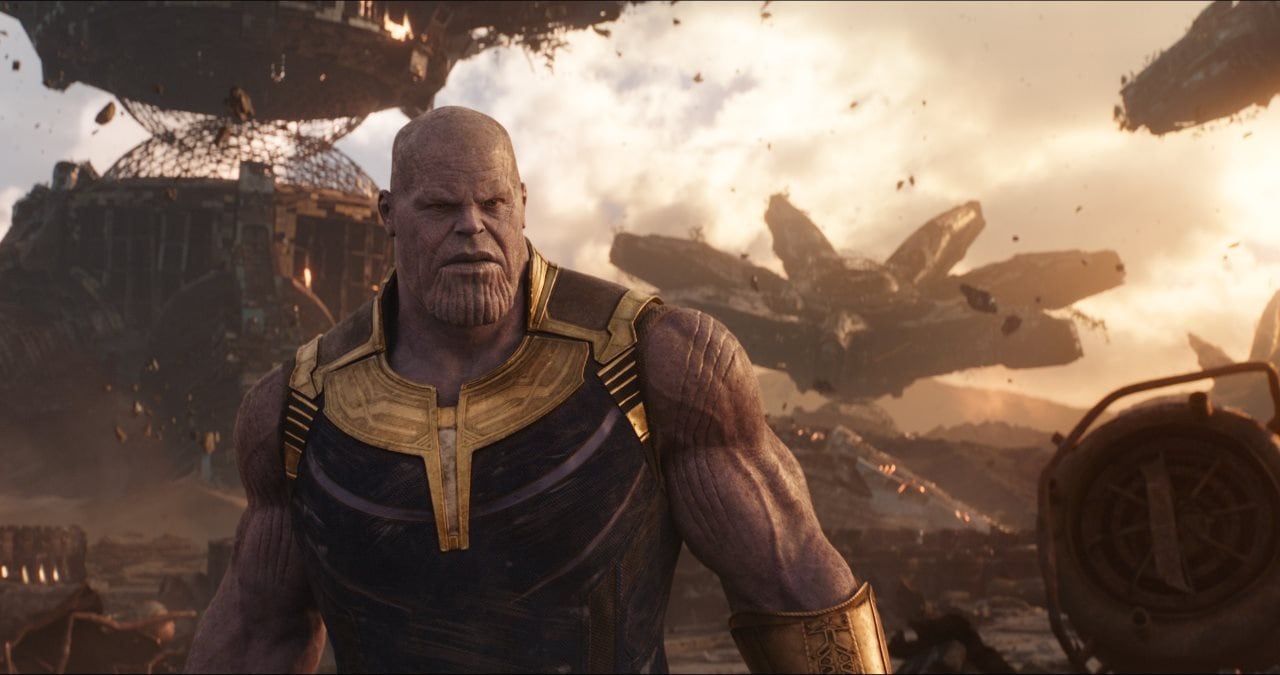
Thanos in Avengers: Infinity War Photo Credit: Marvel/Disney
But moment to moment, Infinity War is an exhilarating and shocking ride. When you've so many characters, you also have so many powers and abilities to deal with. Infinity War has a few action set-pieces that involve everyone chipping in with their ideas, especially a showdown with Thanos on his home planet. Those provide the cool comic-book moments fans are eager for, in addition to multiple surprise entrances that garnered the biggest roars at the premiere screening. The action does become a tad generic elsewhere, and there are some problems with visual effects (blue screen work, to be precise) which can be distracting and noticeable especially in IMAX.
And while every character gets a heroic moment, they don’t have equal screen time. It’s not hard to imagine more prominence for Black Panther if Marvel knew about its record-breaking success beforehand. Those are minor concerns in what is otherwise a competent and enjoyable chapter, which remarkably checks most boxes: it's sombre and thoughtful at times, has plenty of laughs and epic moments, and neatly brings together its large ensemble while telling a cohesive story. Best of all, it has what Marvel seemed scared of for a decade: stakes. What follows in 2019 can hopefully live up to that.
Company registered 16 percent Year-on-Year (YoY) growth
OnePlus remained at second position with 25 percent market share
Apple secured third spot with 20 percent market share
Riding on the success of its flagship devices like Galaxy Note 8, Galaxy A8+ and the newly-launched Galaxy S9 and Galaxy S9+, Samsung climbed back to the top in the premium smartphone segment in India with 50 percent market share in the first quarter of 2018, a new report said on Friday.
Samsung captured half of the premium segment with 16 percent Year-on-Year (YoY) growth driven by flagships Galaxy S9, Galaxy S9+, Galaxy Note 8 and "online exclusive" Galaxy A8+.
OnePlus remained at the second position with 25 percent market share and Apple at the third spot with 20 percent in the premium smartphone category, said market research firm Counterpoint Research.
Samsung, OnePlus, and Apple contributed to 95 percent of the overall premium smartphone segment.
"Galaxy S9 series promotions were strong both in offline and online channels with offers ranging from cashback, exchange, upgrade and data bundling plans across all major operators," said the report.
Samsung brought Galaxy S9 and Galaxy S9+ to the country on March 16.
In the fourth quarter of 2017, Apple led with a 46.9 percent share of the premium segment, while OnePlus and Samsung trailed with 24.9 percent and 17.6 percent respectively.
The iPhone-maker had a weak start in India as demand for its iPhone 8 and X series declined sequentially in India, said the report.
"Additionally, the Cupertino-based giant had to battle rising import tariffs due to lack of 'Make In India' domestic manufacturing capabilities for its portfolio," the report added.
The import tariffs have increased thrice in the past five months, leading to an increase in the price of already expensive iPhones in India during the quarter.
Apple's share in the premium segment fell as the volumes dipped by a massive 55 percent due to decline in shipments for its iPhone 8 and X series.
The increase in import duty on CBUs to 20 percent during the quarter, led to increase in prices of already expensive iPhones.
OnePlus was the fastest growing brand (over 192 percent) in the segment.
"OnePlus has been maintaining its second spot in the premium segment which it is has been holding since Q3 2017. OnePlus 5T was the best-selling model during the quarter, driven by its limited edition variant launch and expansion in the offline segment," Counterpoint said. The OnePlus 5T had a 25 percent share of the top premium models of the quarter, followed by the Samsung Galaxy S9+ at 17 percent and Galaxy S9 at 12 percent.
The premium smartphone segment remained flat (YoY) but declined 13 percent sequentially due to drop in promotions post festive Q4 2017